When the Sea Becomes a Desert
By Johnson Owino · July 25, 2026
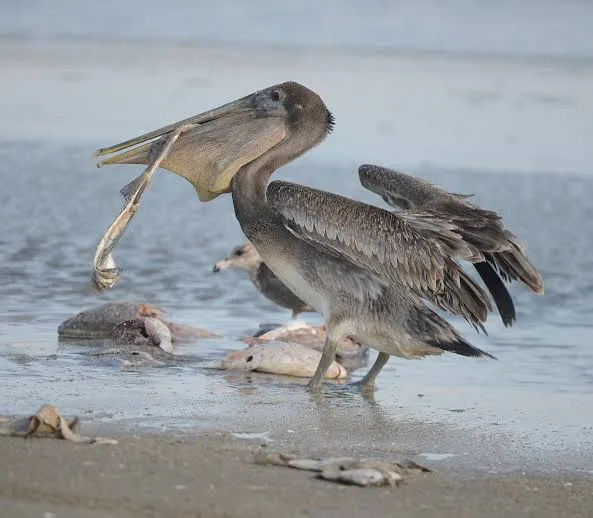
(A juvenile Brown Pelican( Pelecanus occidentalis)attempting to eat fish scraps, seabirds resort to scavenging on shore when prey shifts too deep into cold waters during marine heatwaves:Wildlife Rehabilitation Documentation.)
You might have seen the images. Emaciated seabirds washing ashore, their
bodies too weak to lift off the sand. Brown pelicans, cormorants, and other
coastal birds that should be soaring over the water are instead stumbling onto
beaches and collapsing from exhaustion. It is happening across the world, and
the cause is not a mystery.
The seabirds are starving because
their food has moved beyond their reach. Marine heatwaves have driven
prey like krill, anchovies, and sardines into deeper, colder waters. Many
seabirds, such as brown pelicans, can only dive a few feet.They simply cannot
reach the fish that used to be near the surface. The warm water has also
reduced the cold, nutrient-rich upwelling that sustains the entire food web.
Without those nutrients, the small fish that seabirds depend on become scarce.
The birds are left with empty stomachs and no options. Some have been seen
walking to shore to die within minutes, too exhausted to even fly.
The crisis stretches across the North Pacific and beyond.
Between 2014 and 2016, a
severe marine heatwave known as the "warm blob" devastated seabird
populations across Alaska and the Pacific Northwest. An estimated 4 million
common murres died, representing over half of the state's population.
Carcasses washed up from California to Alaska, and years later, the population
has still not recovered.
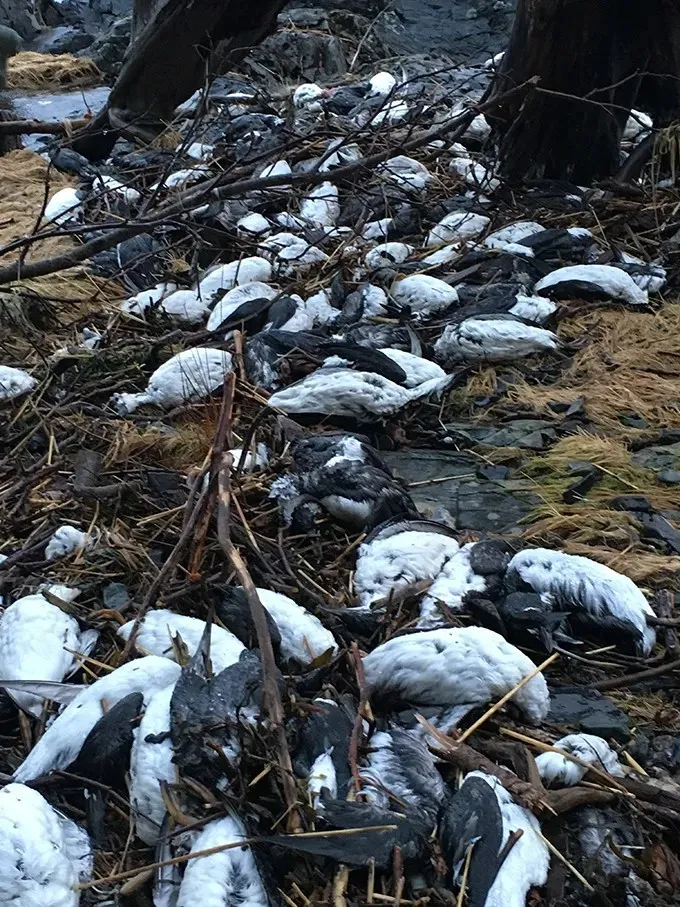
(Common murre (Uria aalga) carcasses piled along an Alaskan coastal shoreline following severe
starvation and exhaustion during a marine heatwave: National Park Service (NPS)
At the same time, between 250,000 and 500,000 Cassin's auklets starved to death from California to British Columbia. The heatwave had reduced the nutritional quality of their zooplankton prey, leaving them without the energy to survive.
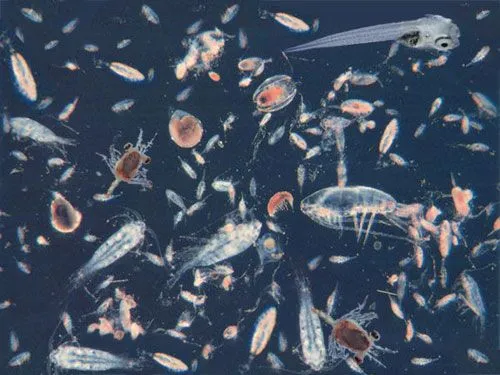
(view of live marine zooplankton, including copepods, larval fish (top right), and various small planktonic crustaceans drifting in dark ocean water: NOAA (National Oceanic and Atmospheric Administration)
In the Northwest Atlantic in
2022, a sudden cold snap and sea-ice changes led to the starvation of thousands
of thick-billed murres off Canada's coast. In the UK and Europe, thousands of
seabirds, including puffins and guillemots, have died in mass mortality events
linked to winter storms that left them exhausted and starved. In the
Mediterranean, an unusual die-off of razorbills has been reported, with
starvation as the primary cause. The pattern is the same everywhere: heat
disrupts the food web, and the birds die.
So what causes these
heatwaves? The immediate triggers are natural. Stalled high-pressure
systems act like a lid, trapping heat and calming winds. Weakened ocean
currents fail to mix cooler deep water with the warm surface layer. Natural
cycles like El Niño redistribute warm water across the Pacific. But these
natural events are now amplified by something far larger. The ocean has
absorbed about 90 percent of the excess heat from global warming.
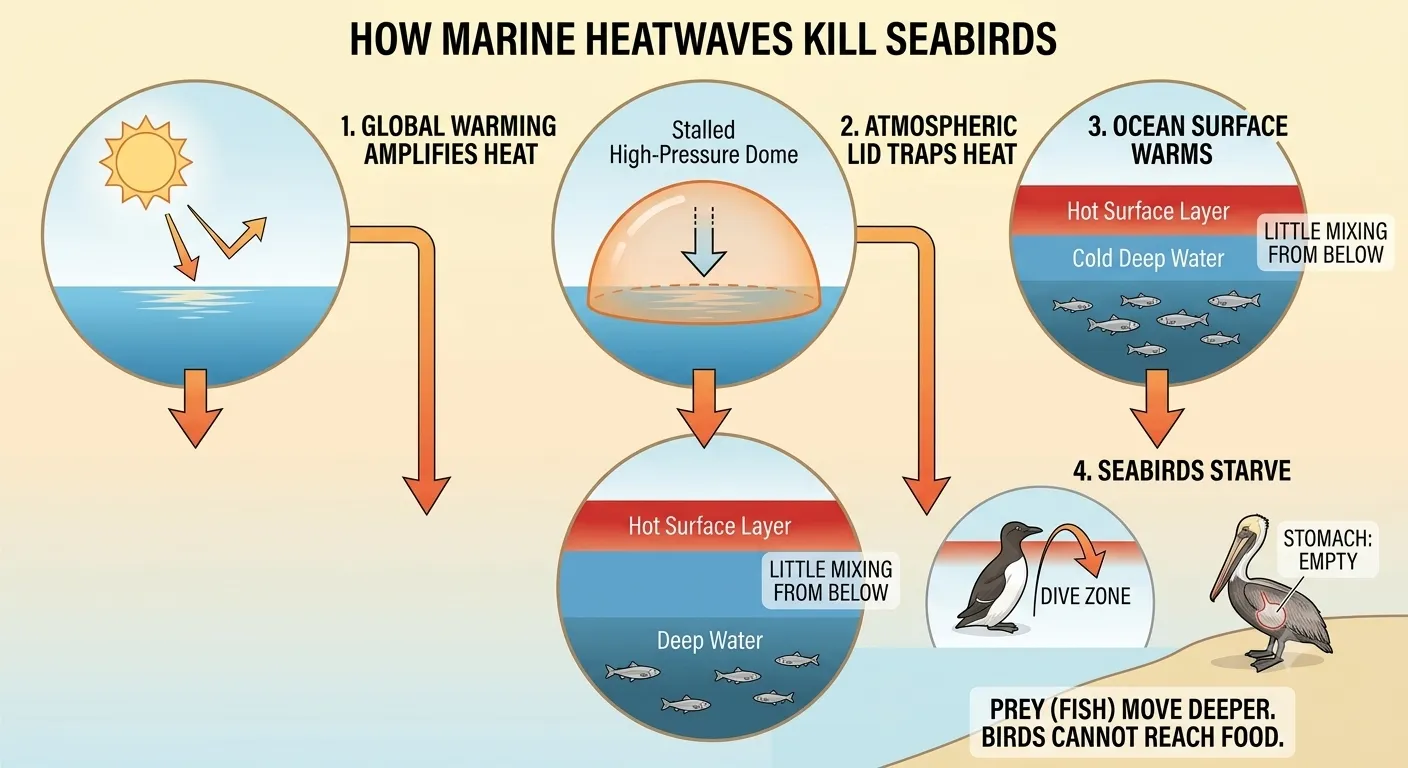
(infographic illustrating how global warming and a
stalled atmospheric heat dome form a marine heatwave.)
Climate change has made marine heatwaves three times more
frequent and longer-lasting than they were in the 1980s. What used to be a rare
event is now routine.
The
seabirds do not know this. They do not understand climate policy or carbon
emissions. But they know something is wrong. They feel it in the warmer water,
in the empty hunting grounds, in the hunger that does not go away. They swim,
hunt, and raise their young in a world that is warming around them. And when
the fish move deeper, they cannot follow. When the storms hit, they cannot
recover. When the heat stays, they starve.
These
birds are not just victims. They are indicators, living warnings of a system under
stress. Their deaths tell us something we already know but often ignore: the
ocean is changing faster than its inhabitants can adapt. And if we do not act,
the beaches will keep filling with the bodies of birds that had nowhere else to
go.
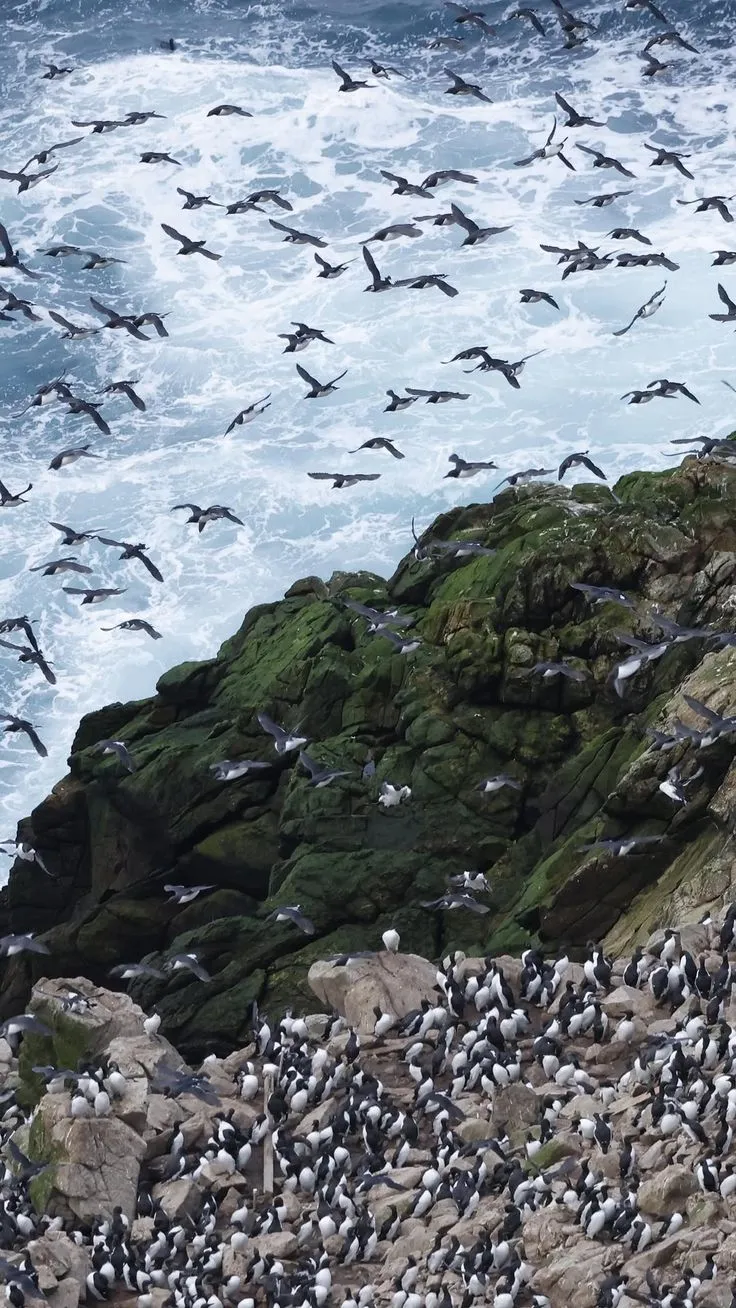
(A large colony of Common Murres (Uria aalge) densely
crowding rocky coastal cliffs, with dozens of birds taking flight in a dense
flock over churning ocean waves below.: U.S. Fish and Wildlife Service (USFWS)
What do you think? At what point do we stop seeing these mass deaths as
isolated tragedies and start seeing them for what they are — the cost of a
world we chose not to cool down? 🕊️
Comments (1)
Log in to join the discussion.
Log in
This is sad😢😢
Hard to write, harder to read. But important.