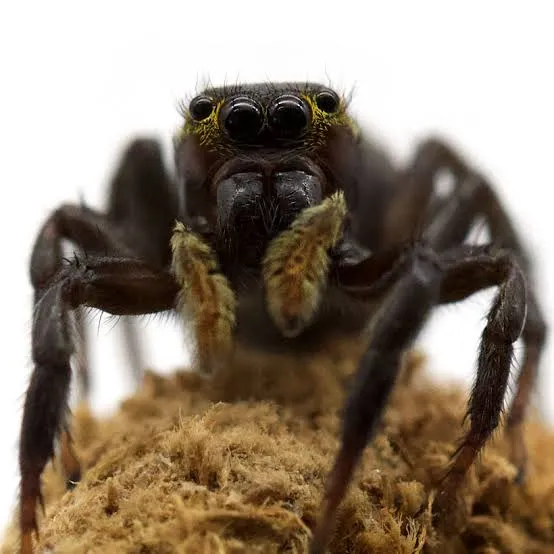
Spider with a Red Mask and a Death Wish
By Johnson Owino · July 11, 2026
(Close-up of a female Hasarius adansoni jumping spider, showing her more uniform, drab dark brown camouflage:Source.Insektenliebe.)
A tiny black spider on your wall, pausing to look at you
before disappearing into a crack. If you live in Kenya, there is a good chance it
was Hasarius adansoni, also known as Adanson’s house jumper. It is one of
the most common jumping spiders in the world, and it has a story that is far
stranger than its size suggests.
This spider is small. Males are about 5 to 6
millimetres long, while females are slightly larger at 6 to 8 millimetres. The
males are mostly black with a striking red patch on their face, almost like a
mask. Their pedipalps, the small appendages near their mouth, are tipped in
white.
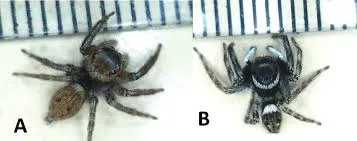
(Scientific comparison photo showing a female (A) and
male (B) Hasarius adansoni side by side underneath a millimeter ruler scale.Researchgate.net)
The females are more subdued, a plain dark brown. At first
glance, the male looks like he is wearing a costume, and in a way, he is. That
red mask is not for decoration. It is a communication tool. When he waves his
legs during courtship, he flashes that red patch at the female to signal that
he is a suitor, not a meal.
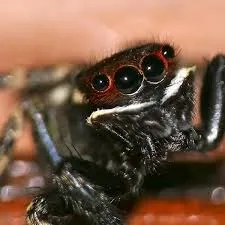
(The males striking red face mask and white
pedipalps:Animal.bio)
That is an important distinction because the female is
aggressive. She is known to eat males who approach poorly or fail to impress. The
male performs an elaborate tap-dance, vibrating his legs and showing off his
white-tipped pedipalps. If she approves, mating occurs. If she does not, she
eats him. It is a dance with death, performed on a stage no bigger than a
coin.
Jumping spiders do not jump using muscles alone. They use hydraulics. They pump hemolymph, which is spider blood, into their back legs, causing them to extend explosively like a spring. This allows them to leap up to 30 times their body length. They always land precisely, using a safety dragline of silk that acts like a bungee cord.
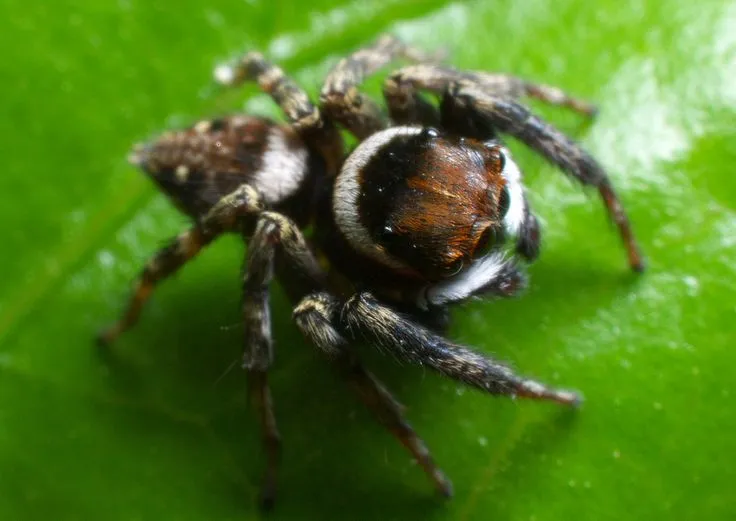 (A male getting ready to deploy it’s hydraulic leap:Commonswikimedia.org)
Their vision is also extraordinary.
While most spiders have poor eyesight, jumping spiders have sharp, almost
4K-like central vision. Their two large front eyes have tiny movable retinas
that scan images like a camera. They can track humans when we move, giving
them better depth perception than an elephant. They are the only animals
known to use one part of their vision that is permanently out of focus to judge
distance.
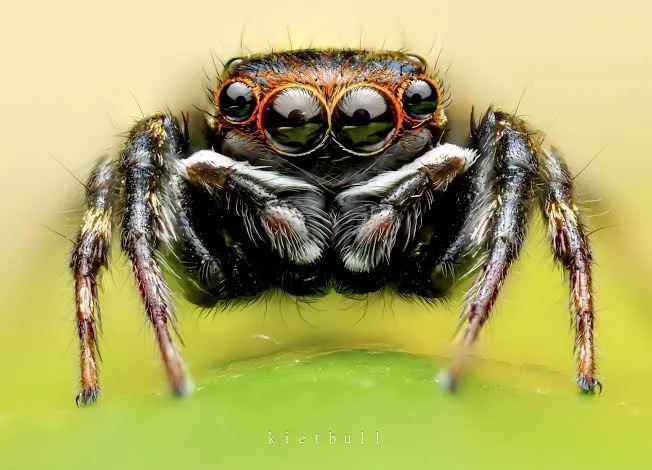
(The incredible forward facing eyes that give them
4K-like vision : Shutterstock Image by kietbull)
Hasarius adansoni is native to Africa and the
Middle East, but it has spread to warm regions across the world,
including Japan, Australia, India, Brazil, and Europe. It is what scientists
call a cosmopolitan species, meaning it thrives near humans. It prefers warm,
disturbed habitats, which is why you find it on exterior walls, window sills,
and in gardens. In Kenya, there is a confirmed record from Watamu on the Coast,
but it is likely found throughout the country.
Despite its predatory nature, the
Adanson’s house jumper plays a useful role in the environment. It helps control
insect populations, feeding on flies, mosquitoes, and other small pests that
might otherwise become a nuisance. It is a tiny, silent guardian of your home,
keeping the balance without you even noticing. It does not bite humans unless
provoked, and even then, its venom is not dangerous.
This spider has also been one of the most studied jumping
spiders in scientific history. Because it is easy to keep and breed in labs, it
has helped researchers understand spider vision, learning, and mating behaviors
for decades.
The next time you see a small black spider from your wall,
know that you are looking at a , tap-dancing, risk-taking survivor. It is a
creature that has crossed oceans, lived alongside humans for centuries, and
perfected the art of survival in the smallest possible package.
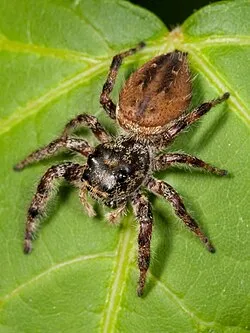
( A female Hasarius adansoni showcasing her dark brown
coloration, mottled patterns, and camouflage body bands.: Wikimedia Commons
Hasarius adansoni category page)
Have you ever noticed them dancing on your wall, or are you just now realizing they have
been watching you all along? 🕷️
Comments (0)
Log in to join the discussion.
Log in