Mountain Bongo’s Long Road Home
By Johnson Owino · August 1, 2026
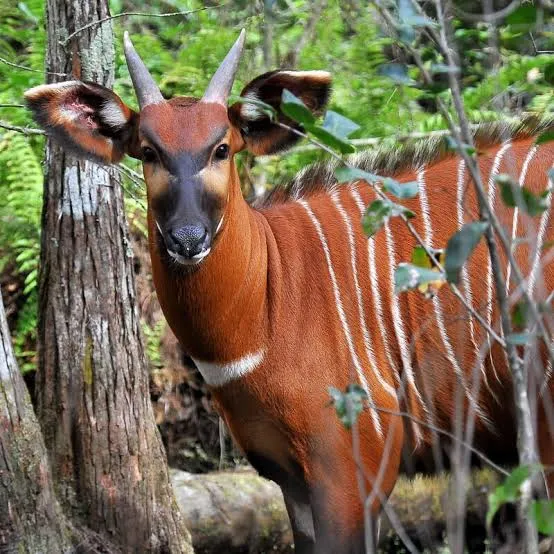
(A mountain bongo blended into dense forest foliage:Lewa Wildlife Conservancy.)
Deep in the misty forests of Mount Kenya, a
chestnut‑coloured antelope with bold white stripes moves like a shadow through
the undergrowth. The mountain bongo is so elusive, so perfectly camouflaged
among the vines and shrubs, that even experienced rangers can walk right past
one without noticing. Standing behind a green bush, a bongo completely
disappears. It has earned its nickname: the ghost of the forest.
That ghost almost vanished forever.
The mountain bongo is the largest of the forest antelopes,they
have impressive spiralled horns, but there is a clear difference between the
sexes. Males are noticeably larger, weighing up to 400 kilograms and standing
taller than females. Their horns are heavier and more robust, with a tighter
spiral than those of females. The males also darken with age, their vibrant
chestnut coats turning almost black as they grow older, while females retain
the bright chestnut colour throughout their lives. This colour change in males
is a sign of maturity, making them darker and more imposing figures in the
forest.
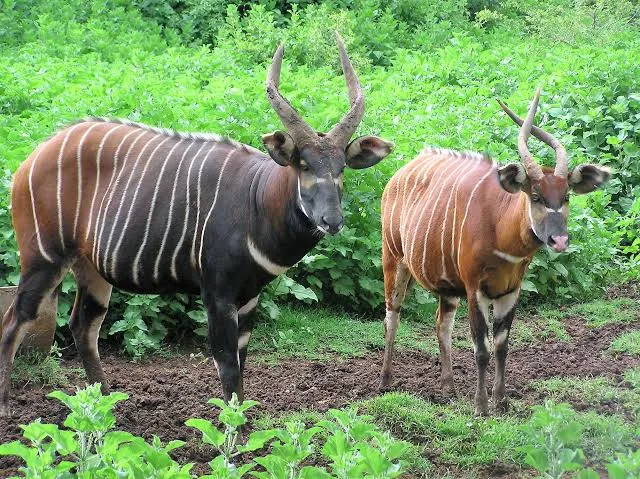
(Two adult mountain bongos showcasing the physical differences between individual adult
coats and horn formations.)
It is a creature of beauty and secrecy, found only in
Kenya’s highland forests — Mount Kenya, the Aberdare Range, Eburu Forest, and
the Mau Forest Complex. No other country in the world has wild mountain bongos.
The decline of the mountain bongo was slow at
first, then devastating. In the 1960s, thousands died in
rinderpest outbreaks, a disease brought by infected cattle. As forests were
cleared for agriculture and human settlement, the shy antelope lost much of its
natural habitat. Poachers hunted them relentlessly for their meat, their prized
chestnut coats, and their distinctive horns. By 1975, the wild population had
dropped from an estimated 500 animals to fewer than 100 today.
By 2019, conservationists feared the mountain
bongo was on the verge of being wiped out entirely. The wild
population became fragmented into small, isolated groups, making natural
breeding difficult. A genetic bottleneck had formed, leaving the remaining
animals vulnerable to disease and inbreeding. Some forest areas now
contained only male bongos, making local extinction inevitable without
intervention.
Ironically, while the wild population in Kenya was
collapsing, bongos living abroad were thriving inside protected breeding
programmes. Those overseas populations became a genetic lifeline for the
species, preserving bloodlines that Kenya would later desperately need.
The first major repatriation happened in 2004. Kenya received 18 mountain bongos from zoos across North America, flown in to become the foundation of a breeding and rewilding programme managed by the Mount Kenya Wildlife Conservancy.
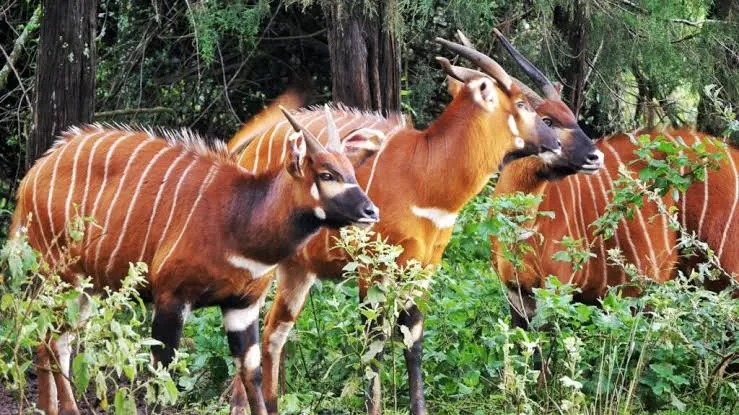
(Mount Kenya Wildlife Conservancy (MKWC), in partnership with the Kenya Wildlife Service (KWS), officially released the first batch of 10 critically endangered mountain bongos (Tragelaphus eurycerus isaaci):Climate lens news.)
The conservancy, located on the slopes of Mount Kenya, began
its work. Over the years, they bred bongos and prepared them for a return to
the wild. In 2022, the first 10 bongos were released into the Mawingu Mountain
Bongo Sanctuary, a 776‑acre protected forest where the animals could learn to
survive without human assistance. By 2024, the sanctuary had recorded wild
births, a sign that the animals were adapting.
In February 2025, Kenya received another historic batch — 17
mountain bongos from Florida, USA.
Then, in April 2026, Kenya welcomed four more male mountain
bongos from European zoos, coordinated by experts from Chester Zoo in England
and the European Association of Zoos and Aquaria. The transfer was the result
of more than 11 years of careful planning.
Today, the Mount Kenya Wildlife Conservancy houses over 100
bongos in its captive breeding programme. The goal is ambitious: to establish
at least 750 wild mountain bongos by 2050.
Technology is playing a crucial role in the
bongo’s recovery. AI‑enabled cameras throughout the conservancy
and parts of Aberdare National Park can detect and differentiate mountain
bongos from other wildlife, tracking them without disturbing their natural
behaviour. As one researcher explained, before AI, they could spend six
hours searching for a single animal. Now they can track them before leaving the
office.
Satellite
surveillance is also being deployed. The Kenya Space Agency
launched Project Centinela, using daily satellite imagery to monitor forest
cover, detect illegal logging, and guide habitat restoration.
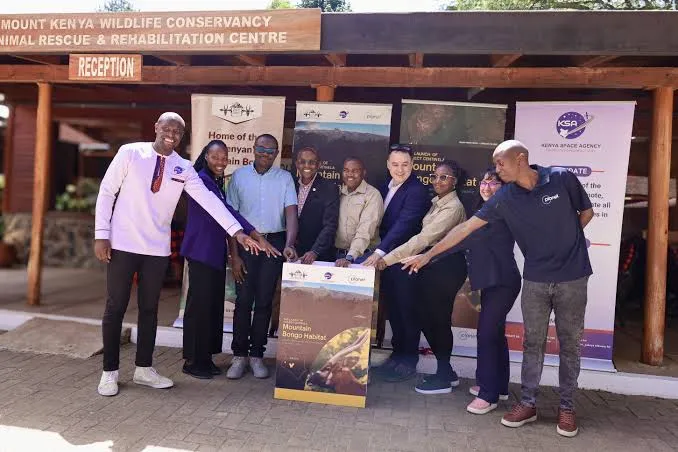
(KSA and MKWC launching Project Centinela:Kenya Space
Agency)
A constellation of over 430 satellites provides daily
coverage of Mount Kenya, allowing conservation teams to detect land cover
changes and respond to threats sooner. The mountain forests where bongos live
supply 80 per cent of Kenya’s water resources, making habitat protection a
national priority.
On the ground, the Bongo Surveillance Project works with
local communities, removing snares, destroying poaching camps, and monitoring
illegal activities like logging and charcoal production. They also run
conservation education programmes, establishing wildlife clubs in schools
adjacent to bongo habitats so that children can learn about the endangered
species they live so close to.
The bongo’s story is a testament to the power of collective
action — a partnership between governments, zoos, conservation organisations,
and local communities.
But the work is far from finished. The mountain bongo still
clings to survival, its future uncertain. Yet for the first time in decades,
that future looks a little brighter. The ghost of the forest is slowly
returning to the shadows where it belongs.
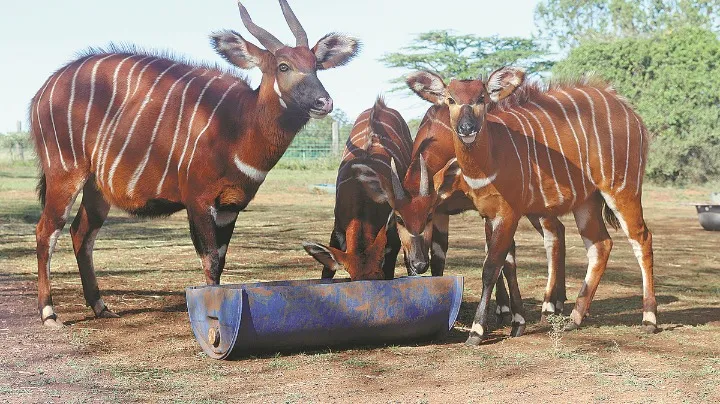
(Tragelaphus eurycerus isaaci)—an adult female and three
juveniles—gather around a halved blue drum feeding trough in an open enclosure;Mount
Kenya Wildlife Conservancy, documenting captive breeding and rewilding
programs.)
What do you think? Have you ever heard of the mountain bongo
before? Does knowing that a species can be brought back from the brink give you
hope for other endangered animals, or does it make you wonder why we let them
get so close to disappearing in the first place? 🦌
Comments (0)
Log in to join the discussion.
Log in