Meet Tasmania’s everyday hopper
By Johnson Owino · April 28, 2026
🦘 Bennett's wallaby
Across the landscapes of Tasmania, from open woodlands to the edges of farmland, the Bennett’s wallaby moves with a quiet confidence that makes it one of the island’s most familiar yet often overlooked animals 🌿. Unlike the more elusive species that hide deep within dense forests, this wallaby thrives in areas where nature and human activity meet, making it one of the most commonly encountered marsupials in the region.
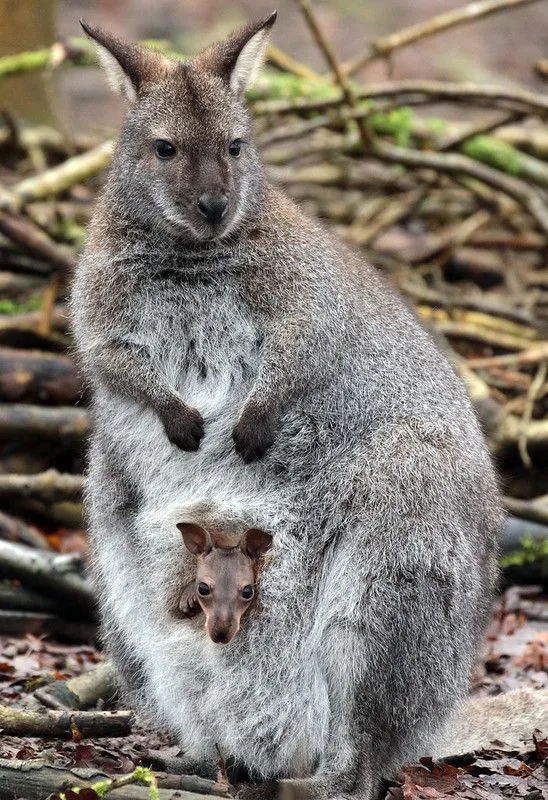
Physically, the Bennett’s wallaby carries the classic features people associate with its kind, though with subtle distinctions that set it apart 👀. Its fur blends shades of grey and brown, with a noticeable reddish tint around the neck and shoulders, giving it a warm, earthy appearance. A pale stripe near the mouth adds a touch of contrast, while its powerful hind legs and long, sturdy tail allow it to move in smooth, controlled hops. It is neither as small as the pademelon nor as large as a kangaroo, but sits comfortably in between—balanced, adaptable, and efficient.
In terms of behavior, this wallaby is primarily active during the cooler hours of the day, especially at dusk and dawn 🌙. During these times, it can often be seen grazing calmly, sometimes alone and sometimes in loose groups. It is alert but not overly skittish, and while it will retreat if threatened, it does not vanish as abruptly as some of Tasmania’s more secretive species. This balance between caution and visibility is part of what makes it so widely observed.
Its diet is entirely herbivorous, consisting mainly of grasses, leaves, and low-growing plants 🌱. Through its feeding habits, the Bennett’s wallaby plays a subtle but important ecological role. By controlling plant growth and contributing to nutrient cycling, it helps maintain the health and balance of the ecosystems it inhabits. What may seem like simple grazing is, in reality, part of a larger natural system that supports biodiversity.
Like all marsupials, its reproductive process is both fascinating and efficient 👶. The female carries her young, known as a joey, in a pouch where it continues to develop after birth. This adaptation offers protection and mobility, allowing the mother to move freely while ensuring the survival of her offspring. Under favorable conditions, reproduction can occur relatively quickly, contributing to the species’ stable population.
Despite its adaptability, the Bennett’s wallaby is not without challenges ⚠️. As it frequently inhabits areas close to human activity, it is vulnerable to road accidents and, in some regions, hunting. Habitat overlap can also lead to conflict, particularly in agricultural zones. However, its resilience has allowed it to remain one of the more stable and widespread species in Tasmania.

Ultimately, the Bennett’s wallaby represents something essential yet often underappreciated 🌍. It may not possess the rarity of endangered species or the intensity of top predators, but it forms a crucial part of Tasmania’s living landscape. Its presence reflects a functioning ecosystem—one where even the most “ordinary” creatures carry quiet importance.
Comments (1)
Log in to join the discussion.
Log in
Loving this series!!!!❤️
❤️☺️