Hadada Ibis: Nairobi’s Feathered Alarm Clock and African Survivor
By Johnson Owino · June 30, 2026
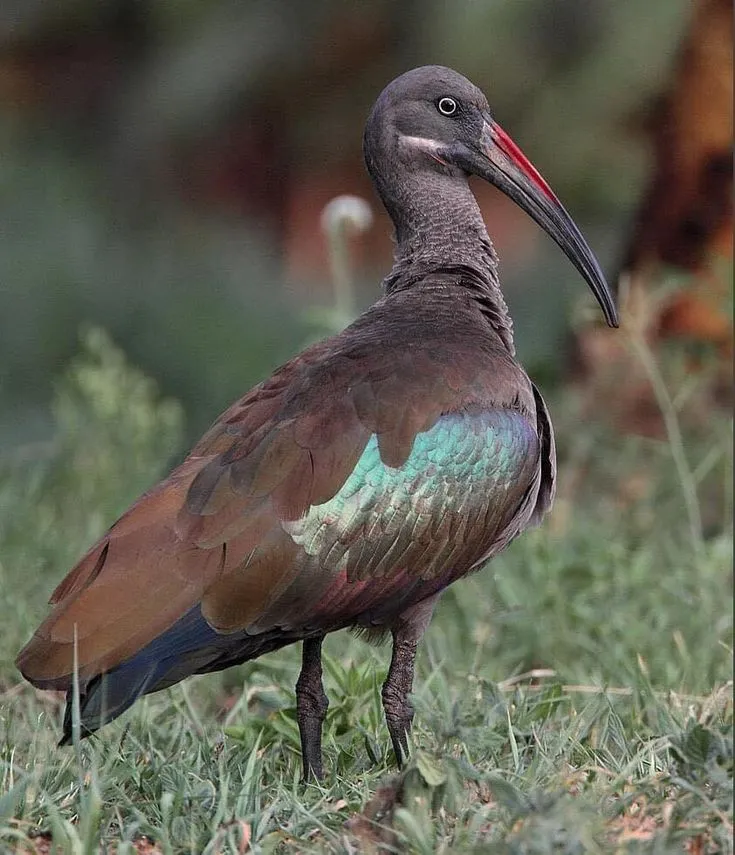
(A mature Hadada Ibis (Bostrychia hagedash) The photograph captures the bird’s distinctive features: the prominent red stripe along the upper ridge of its curved bill, the pale horizontal streak beneath its eye, and the subtle gloss of green-bronze iridescence on its wings.)
If you live in Nairobi, you know the sound before you know the bird. A loud, rasping call that cuts through the morning silence just as the sun begins to rise. “Ha-da-da.” That sound is the Hadada ibis, one of the most recognisable birds in the city and across much of Africa.
The Hadada ibis, scientific name Bostrychia hagedash, is a large bird that grows to about 65 to 76 centimetres in length. It is mostly grey-brown in colour, with glossy green or purple feathers on its wings that catch the sunlight. Its long, curved bill is black and red, and it has a distinct white stripe just below each eye. It is a bird that looks like it belongs in a painting, but it moves through Nairobi’s suburbs like it owns them.
In Nairobi, the Hadada ibis is a familiar presence.
It is seen on golf courses, in parks, on school fields, and even on roadside verges. It walks slowly, using its long bill to probe the soft ground for insects and earthworms. It is often seen in pairs or small family groups, moving across lawns with a calm, deliberate pace. Its call is most common at dawn and dusk, making it one of the city’s most reliable natural sounds.
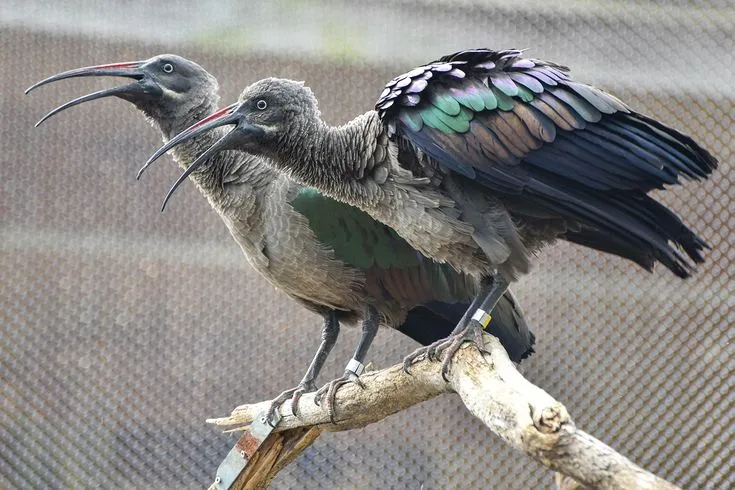
(A pair of Hadada Ibises (Bostrychia hagedash) perched on a thick wooden branch with their long bills open, seemingly vocalizing.Observe in a managed environment)
But the Hadada ibis is not just a bird of the city. It is found across sub-Saharan Africa, from Senegal in the west to Ethiopia in the east and down to South Africa. It lives in a wide range of habitats, including savannas, wetlands, farmlands, and forests. It is a bird that has adapted to human presence and has even expanded its range in some areas due to irrigation and tree planting.
The Hadada ibis is not a picky eater.
Its long, curved bill is perfect for probing soft soil, mud, and grass to find food. It feeds on insects, beetles, fly larvae, earthworms, millipedes, centipedes, and spiders. It also eats snails, small reptiles, and even small frogs. It is considered a gardener’s friend because it helps control pests that damage lawns. Interestingly, it is the only ibis species known to eat fruits and vegetables.

( A pair of Hadada Ibises foraging in a damp, muddy field . One bird is bent forward probing its long, curved bill directly into the mud to feed:Mudflat habitat)
Hadada ibises are monogamous and form long-term pair bonds. They are solitary nesters and do not breed in large colonies like some other ibis species. They can breed year-round, especially after rain, and may produce up to four broods in a single year. Their nests are flimsy platforms of sticks and twigs built in the fork of a large tree, or sometimes on man-made structures like telephone poles. The female lays 2 to 4 eggs, and both parents take turns incubating them for about 26 to 28 days. The chicks fledge after about 33 to 40 days but remain dependent on their parents for a few more months.

(Nesting site. Two young ibis chicks resting closely together within a sturdy, twig-built nest.)
Their nests sometimes have a high mortality rate among chicks, as they can fall from the nest due to the haphazard construction.
Predators and Threats
Their eggs and chicks are preyed upon by genets, monkeys, and monitor lizards, while adult birds are hunted by African crowned eagles and black sparrowhawks. Despite these predators, their population is healthy and considered of Least Concern. In fact, their numbers are increasing in some areas due to their ability to adapt to human-modified landscapes.
The name “Hadada” comes from its loud, distinctive call, which sounds like “haa-haa-haa-de-dah.”
This call is so iconic that it is often used in movies to signify the African bush. The red patch on the top part of its bill becomes more prominent during the breeding season. It has sensory pits at the end of its bill that allow it to detect prey moving underground. In Lesotho, its calls are considered a sign of approaching rain.
The Hadada ibis is a remarkable example of a species that has not only survived but thrived alongside humans. While many bird species struggle with habitat loss and human expansion, the Hadada ibis has done the opposite. It has expanded its range and increased its numbers, particularly in southern Africa, where it has benefited from the spread of irrigation, tree planting, and suburban lawns that provide ideal feeding grounds. Its ability to adapt to human-altered landscapes has turned it into one of the most successful bird species on the continent. It is not threatened, it is not declining, and it shows no signs of slowing down.

(Open field habitat.A Hadada Ibis captured mid-flight against a blurred green hillside background.)
The Hadada ibis is a true African survivor — a bird that has turned the challenges of a changing world into opportunities for growth.
Comments (0)
Log in to join the discussion.
Log in