Fastest Land Predator
By Evans Osumba · March 31, 2026
The Astonishing Cheetah - Nature's Sprinting Marvel
Prepare to be amazed by the incredible cheetah, an animal
that embodies the power of speed and grace on the African savanna. Famous for
reaching speeds up to 70 mph (113 km/h) in short bursts, cheetahs have adapted
to be one of nature’s most efficient hunters. With their lean, flexible bodies
and specialized claws, cheetahs are built for sprinting rather than endurance,
making them unique among big cats. Let’s take a closer look at this phenomenal
predator and uncover what makes it such a remarkable animal. As the fastest
land mammal, the cheetah isn't just a blur on the horizon - it's a testament to
evolutionary ingenuity, honed over millions of years in the unforgiving
crucible of the wild. From its aerodynamic physique to its precarious fight for
survival, the cheetah's story weaves together awe-inspiring feats and urgent
calls for conservation. Whether you're captivated by its lightning chases or
moved by its vulnerability, this deep exploration reveals why the cheetah
remains an icon of raw, unbridled velocity in the animal kingdom.
Appearance: A Sleek Design Engineered for Velocity
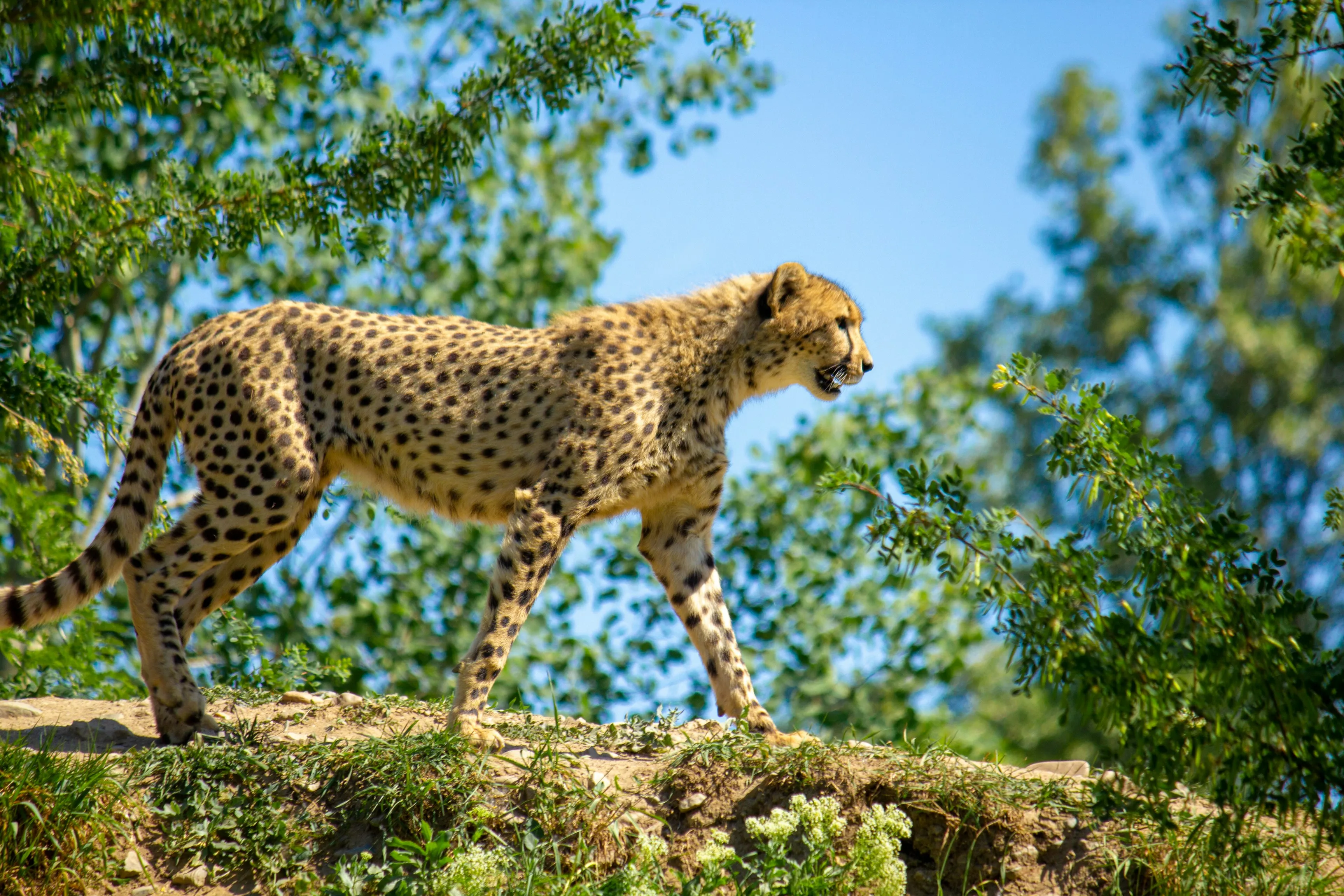
Cheetahs (Acinonyx jubatus) are known for their slender,
lightweight frames, long legs, and distinctive black spots that cover their
golden-tan fur. Their spotted coat serves as excellent camouflage, blending
them into the dry grasslands where they hunt. Unlike other big cats, cheetahs
have black "tear marks" running from the inner corners of their eyes
down to the sides of their mouth. These marks help reduce glare from the sun,
enhancing their focus on prey during hunts. They typically weigh between 70-140
pounds (32-63 kg), and their long tail, which has black rings near the tip,
acts as a stabilizer during high-speed chases.
This lithe build sets cheetahs apart from bulkier felines
like lions or tigers. Measuring 3.2 to 4.6 feet (1-1.4 meters) in body length,
with tails adding another 2.3 feet (70 cm), they tip the scales at a mere
75-140 pounds for adults - about the weight of a large dog, but with the
explosive power of a sports car. Their fur isn't just patterned for stealth;
it's coarse and short, reducing drag during sprints, while the spots create an
optical illusion that breaks up their outline against the savanna's dappled
light. Those iconic tear marks? They're not mere aesthetics - they function
like built-in visors, absorbing sunlight to sharpen vision in the glaring
African midday, much like an athlete's black under-eye stripes.
Under the hood, cheetah anatomy screams speed. Their nasal
passages are enlarged for oxygen intake, lungs expanded for rapid air exchange,
and hearts oversized to pump blood efficiently - adaptations that allow
acceleration from 0 to 60 mph in just three seconds, outpacing a Ferrari.
Semi-retractable claws, unlike the fully sheathed ones of other cats, provide
traction like running shoes, digging into the earth without blunting on kills. And
don't overlook the skull: small and rounded with short ears, it minimizes air
resistance, while forward-facing eyes grant binocular vision for pinpoint prey
tracking. Females are slightly smaller than males, a dimorphism that aids in
their nomadic lifestyle, but both sexes share this blueprint for blistering
bursts. In captivity, these traits shine in educational programs, where
handlers marvel at how a cheetah's stride covers 23 feet per leap at top speed.
Habitat: Masters of the Open Expanse
Cheetahs primarily inhabit grasslands, savannas, and open
plains across sub-Saharan Africa. These landscapes provide the open space
needed for their high-speed pursuits and a plentiful supply of prey. Unlike
lions and leopards, cheetahs avoid dense forests and rocky areas where
sprinting is difficult. In Africa, cheetahs are most commonly found in
countries like Namibia, Botswana, and Kenya, where conservation efforts help
protect their natural habitats from encroachment.
Spanning about 2.3 million square miles historically,
cheetah ranges have shrunk to fragmented pockets totalling less than 10% of
their original extent, primarily in southern and eastern Africa. Namibia alone
hosts over 3,000 individuals - half the global wild population - thanks to
vast, arid savannas like the Kalahari, where visibility stretches for miles,
ideal for spotting Thomson's gazelles from afar. Botswana's Okavango Delta
offers seasonal wetlands that draw herds, while Kenya's Maasai Mara provides
migratory corridors teeming with prey during the wildebeest calving season.
These habitats aren't just flat runways; they're dynamic
ecosystems shaped by seasonal rains and droughts, forcing cheetahs to adapt. In
the dry season, they cluster near waterholes, but their preference for
altitudes below 6,500 feet ensures the terrain stays sprint-friendly - no steep
inclines to sap their explosive energy. A small Asiatic subspecies clings to
survival in Iran's Dasht-e Kavir desert, a stark reminder of their former
Eurasian glory, now reduced to under 50 individuals. Climate change exacerbates
pressures, with shifting rainfall patterns altering grass cover and prey
migration, underscoring the need for transboundary reserves that link these
vital open plains.
Diet and Hunting Technique: Precision Strikes in a Blink
Cheetahs are carnivores that rely on a diet of small to
medium-sized ungulates like gazelles, impalas, and springboks. They’re also
known to hunt young wildebeest, hares, and birds when their preferred prey is
scarce. Cheetahs hunt by sight, using their exceptional vision to scan the
horizon for potential targets. Once they lock onto prey, they approach as
closely as possible, often within 100 feet, before launching a rapid sprint. A
cheetah’s chase rarely lasts more than 20 - 30 seconds due to the immense physical
strain it exerts. During this short burst, they can reach speeds of up to 70
mph (113 km/h), using their tail for balance and their semi-retractable claws
for grip. After a successful hunt, cheetahs eat quickly to avoid encounters
with larger predators like lions and hyenas, which often steal their kills.
Hunting success rates hover at 40-50% - higher than most
predators - thanks to a strategy of stealth over strength. Creeping low on
their bellies, cheetahs use grass tufts for cover, their spotted coats
dissolving into the landscape until the final dash. Vision is key: with eyes
twice the size of a human's relative to body, they spot fawns from 3 miles
away. The sprint? A biomechanical marvel - 18 muscle groups fire in sequence,
spine flexing like a spring to propel those 23-foot bounds. But endurance is their
Achilles' heel; overheating risks mean chases end fast, followed by 30-minute
panting recoveries.
Diet-wise, a single impala (up to 80 pounds) sustains an
adult for days, but cubs demand frequent small meals. Opportunistic, they'll
scavenge or tackle ostrich chicks, but avoid confrontations - unlike leopards'
tree-caching, cheetahs drag kills to shade and gorge on hindquarters first,
prioritizing speed over savouring. For an up-close glimpse, check out
"Cheetahs 101" from Nat Geo Wild, a captivating video that captures
the raw intensity of a chase in slow motion, revealing the fluid grace behind
the fury. In a world of ambush artists, the cheetah's open-field blitz
redefines predation as poetry in motion.
Social Structure and Behaviour: Coalitions, Solitude, and Family Ties
Cheetahs have a unique social structure among big cats.
Males often form small groups known as coalitions, usually consisting of
brothers who stay together for life. This coalition structure gives male
cheetahs a territorial advantage, allowing them to defend larger hunting areas
from rival males. Female cheetahs, on the other hand, are solitary and tend to
be nomadic, moving across large territories to find food for themselves and
their cubs. Females only interact with males during the mating season, after
which they raise the cubs on their own. Cheetah cubs stay with their mothers
for up to two years, learning essential hunting and survival skills before
venturing off independently.
This blend of camaraderie and independence sets cheetahs
apart in Felidae. Coalitions - typically 2-3 brothers, sometimes up to four - boost
survival by 83%, as they cooperatively hunt larger prey and fend off intruders,
patrolling territories up to 300 square miles. Bound by sibling loyalty, they
share meals and grooming, chirping like birds in greeting—a vocal quirk unique
to cheetahs. Females roam solo across 150-600 square miles, driven by prey
availability, teaching litters of 3-5 cubs through mock chases and play-fights
that build speed and coordination.
Mating is fleeting: oestrus lasts days, with males detecting
females via scent. Gestation spans 90-95 days, birthing in concealed dens. Cubs
face brutal odds - up to 90% mortality from predators like hyenas, who target
the spotted "playful" mimics that draw danger. By 20 months, young
males form coalitions, females disperse. Behaviourally, cheetahs purr, hiss,
and "stutter" during chases, but lack roars, their lightweight
larynxes tuned for breath over bellow. In human care, this sociability shines -
rehabbed cheetahs’ bond with handlers, offering a window into their gentle,
non-aggressive core.
Conservation Status: A Race Against Extinction
Currently, cheetahs are classified as vulnerable, with an
estimated 6,700 individuals remaining in the wild. Their populations are under
significant pressure due to habitat loss, human-wildlife conflict, and the
illegal pet trade. Fragmented habitats make it difficult for cheetahs to
maintain genetic diversity and access enough space for hunting. Conservation
organizations are working tirelessly to create protected areas and educate
local communities about the importance of preserving cheetah habitats. Programs
like habitat corridors, which connect isolated populations, are vital for
ensuring the long-term survival of these incredible animals.
As of 2025, the global wild population hovers around 7,100,
with over 80% in unprotected lands vulnerable to rancher conflicts - cheetahs
blamed for livestock losses despite preferring wild game. Low genetic
diversity, a bottleneck from just seven ancestors 10,000 years ago, hampers
resilience, with 10% cubs born deformed. The Asiatic cheetah teeters at under
50 in Iran, while African numbers concentrate in Namibia (3,000+). Threats
compound: poaching for pelts and cubs fuels a black market, climate shifts dry
savannas, and fences block migrations.
Hope flickers through initiatives like the Cheetah
Conservation Fund, which trains herders in guardian dogs and non-lethal
deterrents, reducing retaliatory killings by 90%. Transfrontier parks, like
Kavango-Zambezi, forge corridors spanning 1.1 million square miles. Captive
breeding exceeds 400 worldwide, but rewilding challenges persist - hand-reared
cheetahs struggle with instincts. Community-led eco-tourism in Botswana
generates $40 million annually, proving coexistence pays. Yet, without scaling
anti-poaching and land restoration, projections warn of 50% decline by 2050.
The cheetah's plight demands global action - sign petitions, support NGOs, and
advocate for wild spaces.
The Cheetah's Legacy: Speed as a Symbol of Survival
Cheetahs are not just remarkable for their speed; they’re a
symbol of adaptability and resilience in a world that’s constantly changing.
Observing a cheetah in action is truly mesmerizing, and it serves as a reminder
of the beauty and diversity of the animal kingdom. Whether you’re a wildlife
enthusiast or simply intrigued by nature’s fastest land animal, the cheetah’s
story is one of survival and awe. In an era of vanishing wilds, this sprinting
sentinel urges us to run - not away, but toward preservation. By championing
their cause, we safeguard not just a predator, but a pulse of the savanna's
untamed rhythm.
Sources
Key facts on appearance, habitat, diet, hunting, social
structure, and conservation are informed by wildlife organizations and
encyclopaedic references.
- Cheetah
Conservation Fund: Describes diet of gazelles and impalas, plus
habitat needs. Link
- Smithsonian's
National Zoo: Highlights speed (60-70 mph) and acceleration feats. Link
- IFAW:
Covers Asiatic cheetah diet (sheep, ibex) and broader threats. Link
- Wikipedia:
Provides speed estimates (up to 80 mph) and anatomical adaptations. Link
- WWF:
Confirms status as fastest land mammal (60-70 mph). Link
- SeaWorld/United
Parks & Resorts: Explains muscle fibres for sprinting over
endurance. Link
- Natural
Habitat Adventures: Discusses prey behaviour like impala movements at
night. Link
- Big
Cat Rescue: Lists varied prey including wildebeest calves and hares. Link
- African
Wildlife Foundation: Notes timid nature and top speeds (60-75 mph). Link
- Maryland
Zoo: Emphasizes Thomson's gazelle as primary food source. Link
Comments (0)
Log in to join the discussion.
Log in