Do You Know How Many Eagles Soar Over Kenya?
By Johnson Owino · October 3, 2026
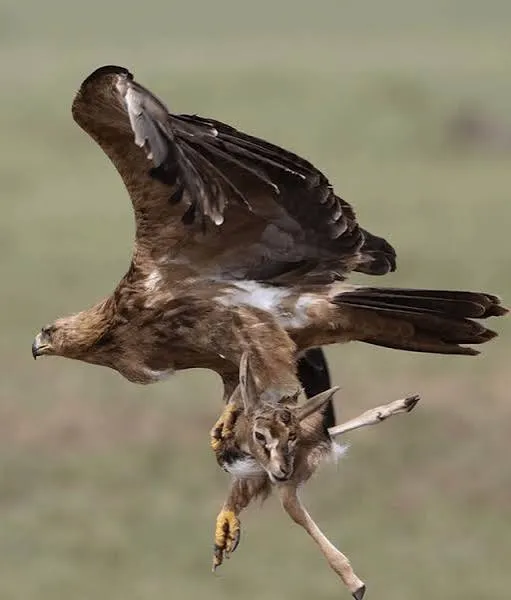
(Captured by safari guide and photographer James Nampaso in the Maasai Mara National Reserve in Kenya: A dramatic wildlife moment featuring a tawny eagle in mid-air carrying a young Thomson's gazelle fawn in its talons.)
Every year, when the northern skies turn cold, an avian army
pours into Kenya from Eurasia. Steppe Eagles — thousands of them ride the thermals down from their breeding
grounds, joining our resident raptors for the season. So on any given
day, the answer is more than you'd think.
I want to introduce
you to a local that doesn't need to travel to be extraordinary. It's been here
all along, and it might be the craftiest bird of prey in the savannah.
The Tawny eagle is
built for wide, open country. You'll find it across the
savannahs, grasslands, and semi-deserts of Africa and parts of Asia — anywhere
there's enough open ground to hunt and enough sky to circle. In Kenya, it's
most at home in the great grassland expanses, from the Maasai Mara to the
northern rangelands.
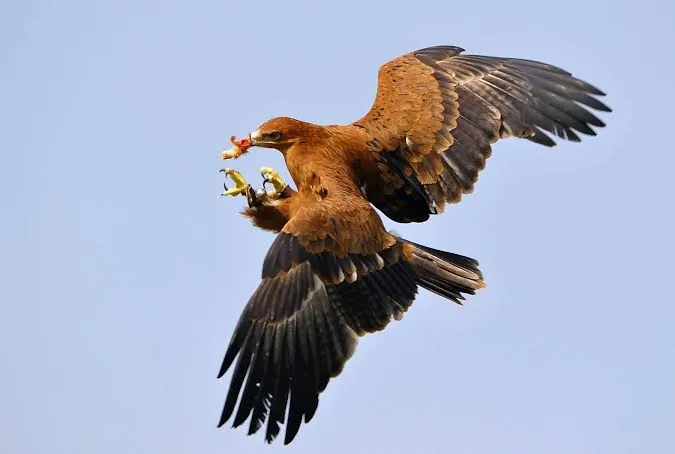
(Photo taken by Alan Benson at the Hawk Conservancy Trust in England.It depicts a tawny eagle (Aquila rapax) mid-flight showcasing its tawny-colored upper plumage, dark flight feathers, and powerful yellow feet)
It's a large bird, with a wingspan that can stretch beyond
1.6 metres, and its plumage shifts through shades of brown — from pale sandy to
deep chocolate — depending on the individual and the region. That variation is
part of why it's so often mistaken for other eagles, especially the migratory
Steppe Eagle that visits each winter.
The opportunist hunter of the raptor world.
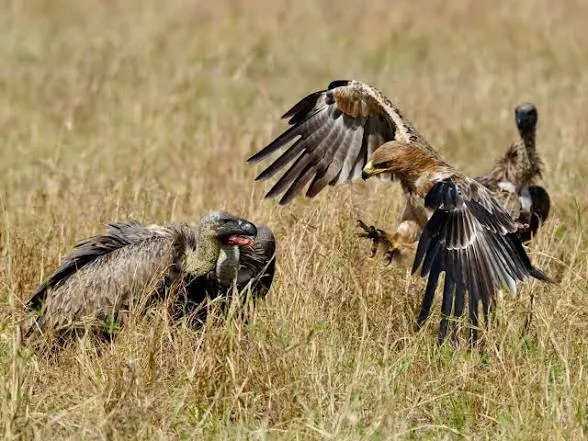
(Documented
by photographer Martin Weru in the Maasai Mara National Reserve birding community:
A confrontational scene where a tawny eagle lands aggressively with
widespread wings to challenge a white-backed
vulture over a kill in the tall grass.)
And it works. The Tawny eagle is one of the most successful
scavengers in Africa, because it plays the game smarter, not harder. When it
does hunt for itself, it targets small mammals, birds, reptiles, and insects —
and it's not above snatching termites out of the air when a swarm takes off.
It eats what's available, and it rarely goes hungry.
Its
scientific name, Aquila rapax, comes from Latin and roughly translates to
"rapacious eagle" — greedy, grasping, predatory. A
fitting title for a bird that treats the whole savannah as its buffet.
It's also the national animal of Ghana, a sign of how much
regard this eagle commands across the continent.
Can you tell a Tawny eagle from a Steppe
eagle? They look almost identical — same size, same brown
plumage, same regal posture.
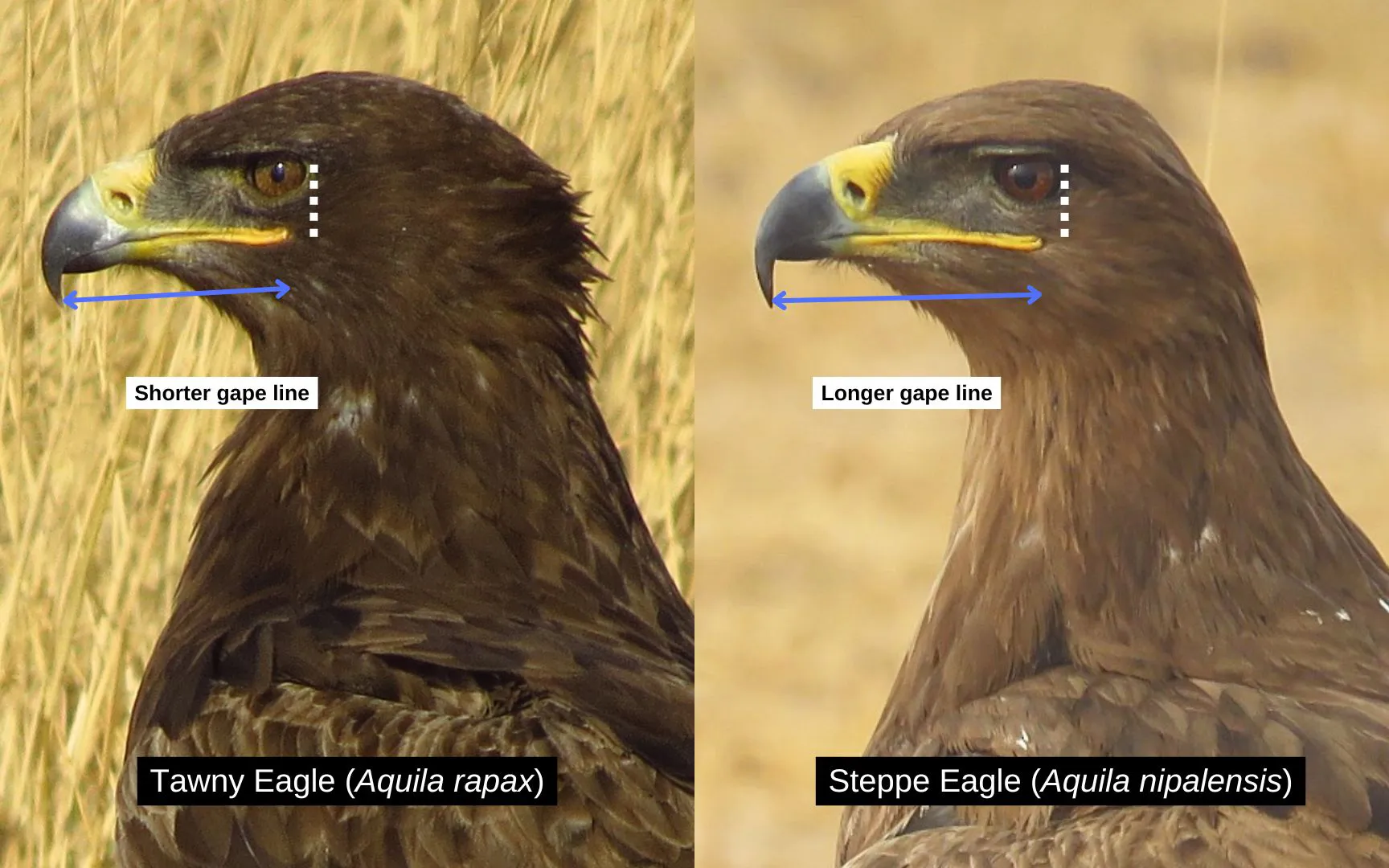
(An
illustration guide by Bird Count India to aid
field identification:Tawny Eagle (left,
with a shorter gape line ending midway under the eye) and a Steppe Eagle
(right, with a much longer gape line extending past the back of the eye).
The secret is in the face. Look at the gape — the yellow
skin at the corner of the mouth. On a Tawny eagle, that yellow extends farther
back, almost toward the eye. On a Steppe eagle, it stops much shorter. Once you
know the trick, you'll never confuse them again.
Despite
its thieving reputation, the Tawny eagle is a devoted parent. Pairs
are generally monogamous and may stay together for years, defending a
territory that can cover many square kilometres. They build large stick
nests high in acacia trees or on cliff ledges, and both parents share the
work of incubating the eggs and feeding the young.
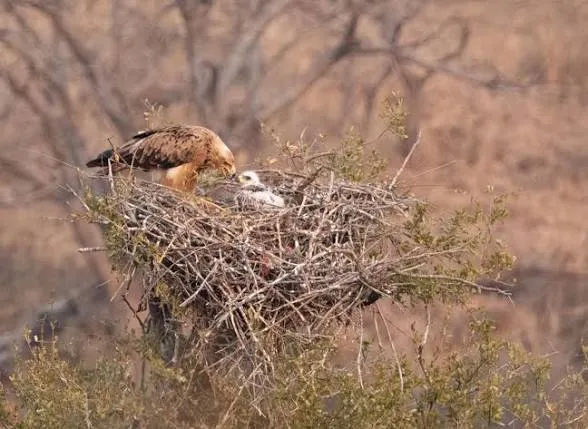
(Captured
by photographer Zeno Swijtink and documented on the Kruger National Park community forums:An
adult tawny eagle actively tending to its single, white down-covered
chick inside their large twig nest located high up in a tree canopy.)
A pair will often reuse the same nest year after year,
adding new sticks and lining each season until the structure becomes enormous.
It's a patient, steady approach to family life — a contrast to the drama of its
feeding habits.
As a scavenger, it plays a crucial role in cleaning up carcasses that would otherwise rot and spread disease across the savannah,
keeping the grassland healthy.
It also acts as an indicator species. The Tawny eagle
sits near the top of the food chain, so when its numbers drop, it's often a
warning that something is wrong lower down — declining prey, degraded
habitat, or poisoned landscapes. Its health reflects the health of the
entire savannah.
The Tawny eagle is classified as Vulnerable by
conservationists. Once common across African savannahs, its
numbers are falling — pushed down by habitat loss as grassland is converted to
farmland, by poisoning from carcasses laced with pesticides meant for
predators, and by persecution from farmers who see it as a threat to
livestock.
Climate change adds another layer of pressure, drying the
landscapes it depends on and shifting the prey it relies on. The same open
plains that host our twenty resident eagle species are shrinking, and the birds
feel it first.
The Tawny eagle isn't the biggest eagle.
It isn't the fastest. It isn't the most majestic in flight.
But it's the survivor — the one that figured out that in a
tough world, the smartest move is sometimes to let someone else do the hunting,
then take the credit. It's resourceful, resilient, and unapologetically clever.
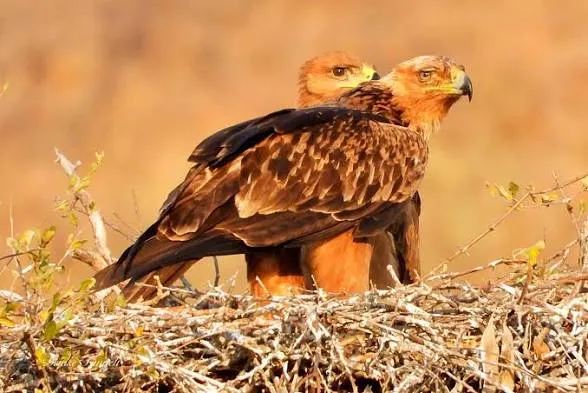
(Taken by
Denise Funnell:A paired adult resting together on top of a large, thick
platform nest woven from dry sticks and thorny brush).
And it does it all while keeping the savannah
clean.
“Has a Tawny eagle ever snatched your meal? And can you tell
it apart from a Steppe eagle now?
Comments (0)
Log in to join the discussion.
Log in